Science
 This page is a Work in Progress as much of the lore/Development for the game is yet to be established.

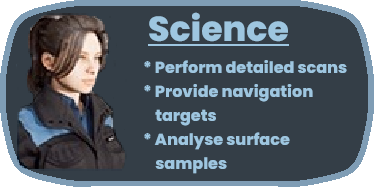
The science department is responsible for the Magellan-class starship's scientific duties and research. Since exploration vessels such as the Magellan with their wide ranging remit must deal with a great variety of possible investigations, the department consists of specialists from many different fields. Science department crew members can be identified by their blue coloured clothing.
Overview
In some ways the entire purpose of the ship's mission is to bring the science department into first hand contact with the mysteries and new knowledge that space exploration affords. To that end the vessel is equipped to allow round the clock expertise to be brought to bear in many disciplines including astronomy, astrophysics, biology, botany, chemistry, geology, linguistics, material sciences, and quantum physics. Most science department work takes place in the laboratories on C Deck; however, two members of the science team are stationed on the bridge to operate and interpret the (Sensors Station and Comms Station) functions.
As the game play evolves science department NPCs and players will engage with increasingly complex scientific operations, although currently crew contribute to gameplay solely on the bridge. A sensors specialist can be spawned at the Sensors Station, where NPCs can operate the sensors in response to commands to, for example, run surveys of celestial objects. As part of ship wide orders now implemented in the gameplay they calculate optimum routes for star system-wide explorations, providing navigation coordinates for the Helm in sequence. Once in position, the sensors station then carries out the necessary short range scanning operation before moving on to the next object, etc. A Comms NPC Officer can currently be spawned at the Comms Station, although their role awaits implementation in future updates. On C Deck itself a decent number of NPCs are routinely enabled at game start who populate the rooms and corridors, but as yet carry on no operational tasks. They do, however, allow testing and monitoring of game system processing resources.
Roles
Chief Science Officer
The Chief Scientific Officer of the department is the lead role. The head of science will create tasks and direct the focus of scientific operations. The Chief Science Officer will be based in the ship's Science Office on C Deck. In the UNSF, the role is assigned to a Lieutenant Commander.
Bridge Officers
The following are officers that will primarily have duties on the bridge.
Sensors Specialist
Sensors Specialists are members of the department who have expertise with the sensor operations. The specialist is placed in charge of the Sensors Station to highlight bodies of interest and perform surveys on objects, also to provide directions for the helm to act upon. They are also expected to assist in ship navigation. In the UNSF the role is ordinarily assigned to crewmen.
Comms Officer
Members of the department who have expertise with communications equipment and linguistics handle Comms tasks. Based on the Bridge, the officer will manage the Comms Station for communications between planets, space stations, organisations and other vessels. They are also expected to work with the Linguistics personnel to decipher new languages. In the UNSF, the role is usually assigned to crewmen.
Lab Officers
Biologist
As members of the department assigned to the Biology Lab, biologists will primarily perform experiments and studies in the lab related to lifeforms, their function and evolution. In the UNSF, the role is assigned to crewmen.
Botanist
As members of the department assigned to the Botany Lab, botanists will primarily perform experiments and studies in the lab related to plant life, their function and evolution. In the UNSF, the role is assigned to crewmen.
Oceanographer
As members of the department assigned to the Oceanography Lab, oceanographers will primarily perform experiments and studies in the lab related to planets' oceans, notably their environment and ecosystems. In the UNSF, the role is assigned to crewmen.
Geologist
As members of the department assigned to the Geology Lab, geologists will primarily perform experiments and studies in the lab related to the rock/soil contents of astronomical objects and their development over time. In the UNSF, the role is assigned to crewmen.
Material Scientist
As members of the department assigned to the Material Science Lab, materials scientists will primarily perform experiments and studies in the lab related to new materials and their structure. In the UNSF, the role is assigned to crewmen.
Chemist
As members of the department assigned to the Chemistry Lab, chemists will primarily perform experiments and studies in the lab related to new chemicals, their structure and interaction with other agents. In the UNSF, the role is assigned to crewmen.
Astronomer
As members of the department assigned to the Astronomy Lab, astronomers will primarily perform experiments and studies in the lab related to celestial objects, including stars and planets. In the UNSF, the role is assigned to crewmen.
Astrophysicist
As members of the department assigned to the Astrophysics Lab, astrophysicists will primarily perform experiments and studies in the lab related to the physics and chemistry of celestial objects. In the UNSF, the role is assigned to crewmen.
Quantum Physicists
As members of the department assigned to the Quantum Physics Lab, quantum physicists will primarily perform experiments and studies in the lab related to quantum mechanics: the physics of matter and light below the atomic scale. In the UNSF, the role is assigned to crewmen.
Linguist
As members of the department assigned to the Linguistics Lab, linguists will primarily carry on studies in the lab related to discovered languages, both in written and verbal forms. In the UNSF, the role is assigned to crewmen.
Duties on Ship (Gameplay)
- perform detailed scans from the bridge
- provide navigational coordinates for pilots
- analyse surface samples, artifacts and various materials
- study and interpret scan data
- develop new technologies from data